France 2026
Mark Finn
March 7-14
This early spring tour took us to France, with the first part spent in Provence, in the contrasting landscapes of the Camargue, La Crau and Les Alpilles, before moving on to the spectacularly mountainous island of Corsica. Highlights were too many to list in full, but in Provence included spectacular flocks of Greater Flamingo and Glossy Ibis, salmon-pink breeding-plumaged Slender-billed Gulls, a vagrant pair of cerise-pink Lesser Flamingos, unusually showy performances from singing Moustached Warblers, a territorial Eurasian Eagle-Owl that repeatedly flew circuits of a hill-top, a flock of 50 Little Bustards strutting around and starting to display, and excellent views of Iberian Grey Shrike and Eurasian Hoopoe. On Corsica we enjoyed prolonged close looks at the endemic Corsican Nuthatch and Corsican Finch, and also at specialities such as Marmora’s Warbler, Italian and Rock Sparrows, Audouin’s Gull and the endemic subspecies of Eurasian Treecreeper, while simply jaw-dropping close eye-level views of a Bearded Vulture meant that species was a serious contender for ‘bird of the trip’.
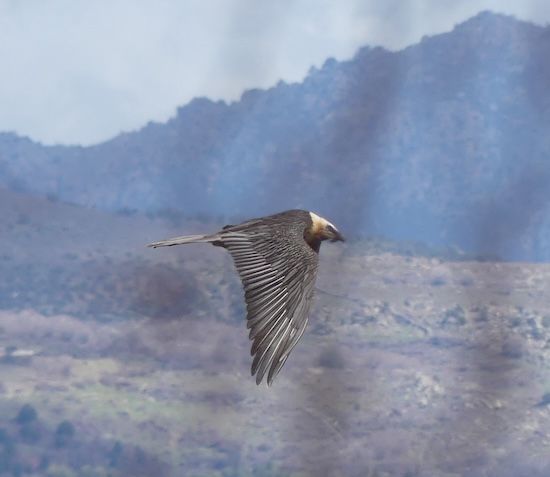
Bearded Vulture
7 March: La Crau and Les Alpilles
Following an on-time arrival from London, our first taste of French birding saw us heading into the steppe-like habitat of La Crau. Crested Larks serenaded us with their fluty songs and Common Linnet and Corn Bunting were particularly abundant. A couple of pairs of Iberian Grey Shrikes put on a show, perching up and occasionally hovering while hunting for prey, while a Eurasian Hoopoe was equally obliging as it fanned its splendid crest and then sat up on a bush for a better view. Raptor highlights included Black Kite, Merlin and a fine male Hen Harrier. Bird of the day was Little Bustard, with a flock of 10 birds flying past us and then heading off high into the distance. On the drive out we enjoyed good views of a pair of White Storks and half a dozen Cirl Buntings.
A couple of brief stops in Les Alpilles added Northern Raven, European Serin and Eurasian Crag Martin, while a flock of at least 2,000 migrating Mediterranean Gulls moving overhead provided a remarkable spectacle and sound as they uttered their slightly comical calls. Aside from the birds, seeing good numbers of impressive-looking Giant Orchids was another highlight of an excellent first day in France.
8 March: Les Baux and Eastern Camargue
A pre-breakfast visit to Les Baux-de-Provence resulted in great views of Blue Rock Thrush, Sardinian Warbler and Black Redstart. Several Alpine Swifts tumbled down from up high to perform acrobatics above the town and other good birds included Eurasian Crag Martin and Woodlark.
Our route into the Camargue took us along a minor road that passed through farmland packed with hundreds of Corn Buntings and dozens of Common Cranes, along with two Merlins. This agricultural backdrop soon transformed to a wetland area absolutely crammed with birds. Perhaps most impressive were the hundreds of Glossy Ibis carpeting the shallow pools, but there were also large numbers of Greater Flamingo, three egret species, Common Shelduck, Pied Avocet and Black-tailed Godwit. Eurasian Bittern and Common Kingfisher were heard, while Zitting Cisticola, Common Reed Bunting, Green Sandpiper, Ruff, Eurasian Teal and Eurasian Spoonbill also joined the rapidly growing tour list.
In the afternoon we headed down to the Mediterranean via the saltpans at Salin-de-Giraud. As we progressed towards the coast, passing mini-mountains of salt as we went, the numbers of birds increased with each lagoon we checked. There were hundreds more flamingos – some displaying and some showing at exceptionally close range – plus hundreds of waders including Sanderling, Dunlin, Ruff, Little Stint, and Ringed, Little Ringed and Kentish Plovers. The grand finale saw at least 70 Slender-billed Gulls – many inimpressively pink-tinged breeding plumage – on the pools adjacent to the Mediterranean, all at close range and very animated and vocal. Sandwich Tern and Mediterranean Gull were patrolling the Plage de Piemanson.
We rounded off a superb day with an exceedingly cute Coypu beside a marshy area, a Black-necked Grebe and three Red-breasted Mergansers on Étang de Vaccarès, and a Eurasian Stone-curlew giving its eerie wailing call close to dusk.
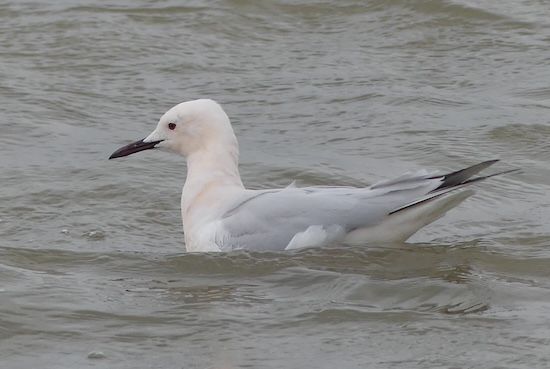
Slender-billed Gull
9 March: Western Camargue and Les Baux
With a deluge at the start of the day, we headed to Pont de Gau reserve in the hope that we might find some shelter as well as good birds. We needn’t have worried, though, because the rain quickly cleared as we watched hundreds of Greater Flamingos and other waterbirds at exceptionally close range. As we made our way around the trail a couple of Moustached Warblers were singing within metres of us but remained resolutely hidden from view in the dense reedbed. Soon after a Purple Swamphen gave great views as it preened in the now hazy sun. Appropriately this was the start of a little purple patch in terms of birding, as a different male Moustached Warbler put on a fantastic show and gave jaw-dropping views as it sang its heart out, which seemingly impressed a female that showed up briefly. No sooner had the warbler show ended than a Eurasian Penduline Tit called several times and then put in a fleeting appearance.
Well pleased with our morning, we headed the short distance to some pools outside the seaside town of Santes-Maries-de-la-Mer, where within minutes we were watching two Lesser Flamingos – a predominantly African species that is something of a mega-rarity in Europe. With their day-glo pink plumage and other-worldly staring eyes they made for a memorable sighting. While eating our lunch we watched the flamingos feeding, then preening and settling down for a nap. Other birds of interest here included a mixed flock of Barn Swallows and Common House Martins, two Green Sandpipers and a showy Crested Lark.
In the afternoon the rain returned but we managed to outflank it by driving along a minor road on the edge of the Camargue, where highlights included two Eurasian Stone-curlews, a small flock of European Golden Plovers and a ‘cloud’ of hundreds of Glossy Ibis rising up en masse from a paddy field.
An evening excursion close to Les Baux resulted in memorable views of a vocal Eurasian Eagle-Owl perched on a rocky outcrop and then flying several circuits around the hill. Its long ear-tufts looked quite remarkable at they blew in the breeze! Then it was time for another excellent dinner in one of the superb local restaurants to round off a great day.
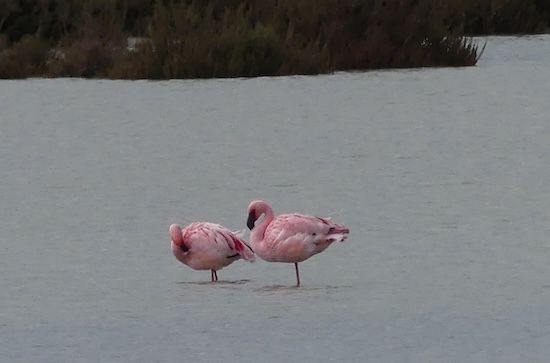
Lesser Flamingos
10 March: Les Baux, Mont Ventoux and Eyguieres
Alpine Swifts were out in force at Les Baux in the morning, with at least 15 screaming around and performing acrobatics. Several Blue Rock Thrush, Black Redstart, European Serin and Eurasian Crag Martin were among the other highlights, while Woodlark and Red-legged Partridge called from the farmland below.The lower slopes of Mont Ventoux produced new trip birds in the form of Goldcrest, Eurasian Blue Tit and Short-toed Treecreeper. Up around Chalet Reynard we added Red Crossbill and a close Northern Goshawk that perched in a tree and then flew off down the hill like a ground-hugging missile. After lunch the weather closed in, with first sleet and then torrential rain, so we retreated to lower ground.
At Eyguières airfield the weather was more clement and the site proved to be very productive. The undoubted highlight was a loose flock of at least 50 Little Bustards, which gave great views through the scope as they strutted around, occasionally displaying; and at one point they all took off together in a single flock before circling round and settling back down. A Black Kite and a male Hen Harrier passed through while a pair of Eurasian Stone-curlews was spooked by an aircraft taking off. Groups of Corn Bunting, Common Linnet and Eurasian Skylark flew around, and a flock of at least 500 Mediterranean Gulls – displaying a wide variety of plumages – gradually gathered on the field before all taking off and presumably continuing on their migration.
11 March: L’Étang de Biguglia
Our early flight to Corsica ran on time and we were out birding around Lake Biguglia by mid-morning, immediately enjoying superb views of flocks of Spotless Starlings and Italian Sparrows at close range. The fields close to the airport were very ‘birdy’, holding a pair of Eurasian Stone-curlews, while common birds included Black Redstart, European Stonechat, Corn Bunting, Zitting Cisticola, Common Chiffchaff, Sardinian and Cetti’s Warblers, Meadow Pipit, White Wagtail, Red Kite and Hooded Crow. Lagoons in this area produced Red-crested Pochard, Little Grebe and Western Marsh Harrier. A Water Pipit bathing in a puddle was a great find – it was just starting to moult into breeding plumage and show its pinkish breast.
Following lunch at a beautiful deserted beach, where three Sandwich Terns passed by offshore, we headed up the eastern side of the lake. Water Rail called from the marsh, and Common Pochard, Tufted Duck and Eurasian Wigeon were new for the tour list, while Black-necked Grebes were out in force with more than 50 counted. Hundreds of Greater Flamingos were shimmering in the haze on the far side of the lake, so we drove along the shore for much closer views. Bird of the day was a pristine adult Audouin’s Gull on the beach at our final stopping point before we headed off into the mountains to find our base in the town of Corte.
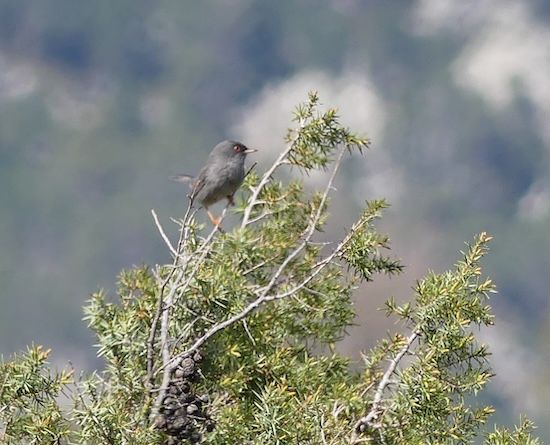
Marmora’s Warbler
12 March: Col de Sorba, Corte area
Today’s weather forecast wasn’t great and after breakfastwe headed to Col de Sorba in persistent rain. However, the sky cleared soon after we arrived and a walk along a track produced the Corsican endemic subspecies of Red Crossbill and Eurasian Treecreeper (corsicana and corsa respectively), plus plenty of Coal Tits, a Firecrest and a few Common Chaffinches and Eurasian Blue Tits. As we were almost back at the road, we heard a loud burst of song from a Corsican Nuthatch deliveredat close range and a pair of these diminutive endemics put on a superb show for several minutes. It was fantastic to have such a close encounter with what will undoubtedly be one of the birds of the trip.
We headed a short distance along the road and immediately found another pair of Corsican Nuthatches that gave even better views. We enjoyed the show for some time as one bird in particular seemed to favour a particular group of trees – perhaps as a potential nesting site? At this site we also had Northern Raven, Common Buzzard, Red Kite and Great Spotted Woodpecker.
Our lunch spot was a picnic table with a stunning view of the mountains, which by now were bathed in full sun (so much for the forecast!). A walk through pine trees and then low scrub produced remarkable close views of a displaying Common Firecrest fanning its fiery crest, followed by several Marmora’s Warbler’s that perched up as they sang, while a pair of Dartford Warblers was just as showy.
On the way back to Corte we made a couple more stops, firstly by a river where a White-throated Dipper was perched on a rock in the middle of the torrent. Then, finally a stop by a field in a small holding produced a pair of Woodlarks and a mixed finch flock containing a dozen Common Chaffinches, several European Serins and about 20 Corsican Finches. Locating the island’s second endemic species was the perfect way to round off a wonderful day.
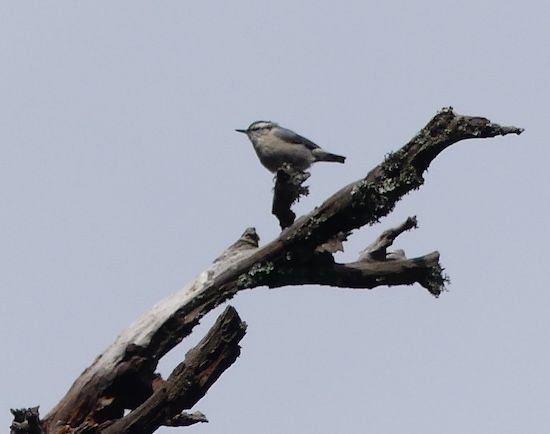
Corsican Nuthatch
13 March: Calacuccia, Col deVergio
Our day began with a walk through the edge of the village and into some farmland near Calacuccia. A Common Firecrest was immediately heard singing and seen well. Corsican Finches were common, with a few pairs seen, followed by a flock of more than 20 that associated with Common Chaffinches. In the same area were more than a dozen Rock Sparrows and several Cirl Buntings. Italian Sparrows and Spotless Starling were much in evidence too, while several Great Spotted Woodpeckers worked the old trees and numerous Red Kites and several Northern Ravens circled overhead.
On the way to Col de Vergio our first stop instantly produced a very loud shout of ‘LAMMERGEIER!’ followed by the unbelievable sight of an adult Bearded Vulture patrolling at head height along a hillside at a distance of no more than 100 metres from where we were standing. Wow! Further along the road, at the col itself, we quickly located a pair of Golden Eagles that were displaying along a ridge with their ‘rollercoaster’ flight and remained in view for more than half an hour. Other birds here included Red Crossbill, at least 10 Woodlarks and Water Pipit.
Continuing into Foret d’Aitone we had excellent views of a Eurasian Treecreeper of the endemic Corsican race of drinking from a puddle on the ground and then ascending the full length of a very long tree trunk, while a Corsican Nuthatch was heard but not seen. Stops in the gorge on the way back to Corte produced Grey Wagtail, Black Redstart, Eurasian Crag Martin and Blue Rock Thrush.
14 March: Étangd’Urbino, Dunes de Prunete
After heading down to the east coast from Corte, our first stop was at the Étang d’ Urbino. We soon found a a small group of Greater Flamingos, plus Great and Little Egrets, hundreds of Yellow-legged Gulls, several pairs of Great Crested Grebes, Common Sandpiper, a pair of Common Shelduck and two or three Sandwich Terns. A couple of European Shags of the race desmaresti were sat on buoys in the water – a new bird for the trip list. Passerines included European Serin, European Goldfinch, Cetti’s Warbler, Italian Sparrow, Cirl Bunting and Spotless Starling.
Further north along the coast at Prunete, a small lagoon held a fine pair of Red-crested Pochard and a Green Sandpiper. This proved to be the ‘herp’ hot-spot of the tour with great views of a pair of Italian Wall Lizards and a small European Pond Turtle. The tour concluded with a seawatch the produced a couple of distant Yelkouan Shearwaters and at least a dozen Scopoli’s Shearwaters, some of which were passing quite close inshore. Sitting on a deserted sandy beach surrounded by great wildlife with a spectacular backdrop of mountains was an apt way to conclude what had been a superb and highly enjoyable tour.
